Patentability vs patent validity. Same search method, different starting point.
How innovative features, citation-network iterations and source verification turn prior-art discovery into a useful patent search report.
Patentability and validity searches ask different questions, but use much the same prior-art search techniques. The crucial difference is where the innovative features come from.
| Patentability search | Validity search | |
|---|---|---|
| Starting point | Invention disclosure | Granted independent claim |
| Features tested | Proposed innovative elements | Actual claim limitations |
| Search method | Database + citation graph + NPL + iterative feature mapping | The same core method, constrained by claim scope and relevant dates |
| Decision supported | File, strengthen or rethink the invention | Identify novelty and inventive-step risks to granted claims |
We used two preliminary knockout-search reports to illustrate the workflow: a LIM-Hardcoat invention disclosure and the granted Vectura patent US 8,303,991 B2. Their technical outcomes matter less here than how the searches were organised.
What should a patent search report contain?
Both Gate IP samples follow a structured sequence. Each section answers a different practical question.
- Basis of review. Define the invention disclosure or the independent claim, the technical scope and the applicable search cutoff. A validity search must also examine priority entitlement and claim support.
- Innovative-feature table. Decompose the subject into identifiable features (F1, F2, F3…). This is the reference framework for the entire search.
- Search strategy and execution log. Record the initial concept table, verified seed patents, search tools, citation-network passes, changed starting points and NPL searches.
- Relevant documents and X/Y/A assessment. Classify reviewed documents provisionally: X for a potential single-document novelty attack, Y for potential inventive-step combinations and A for background.
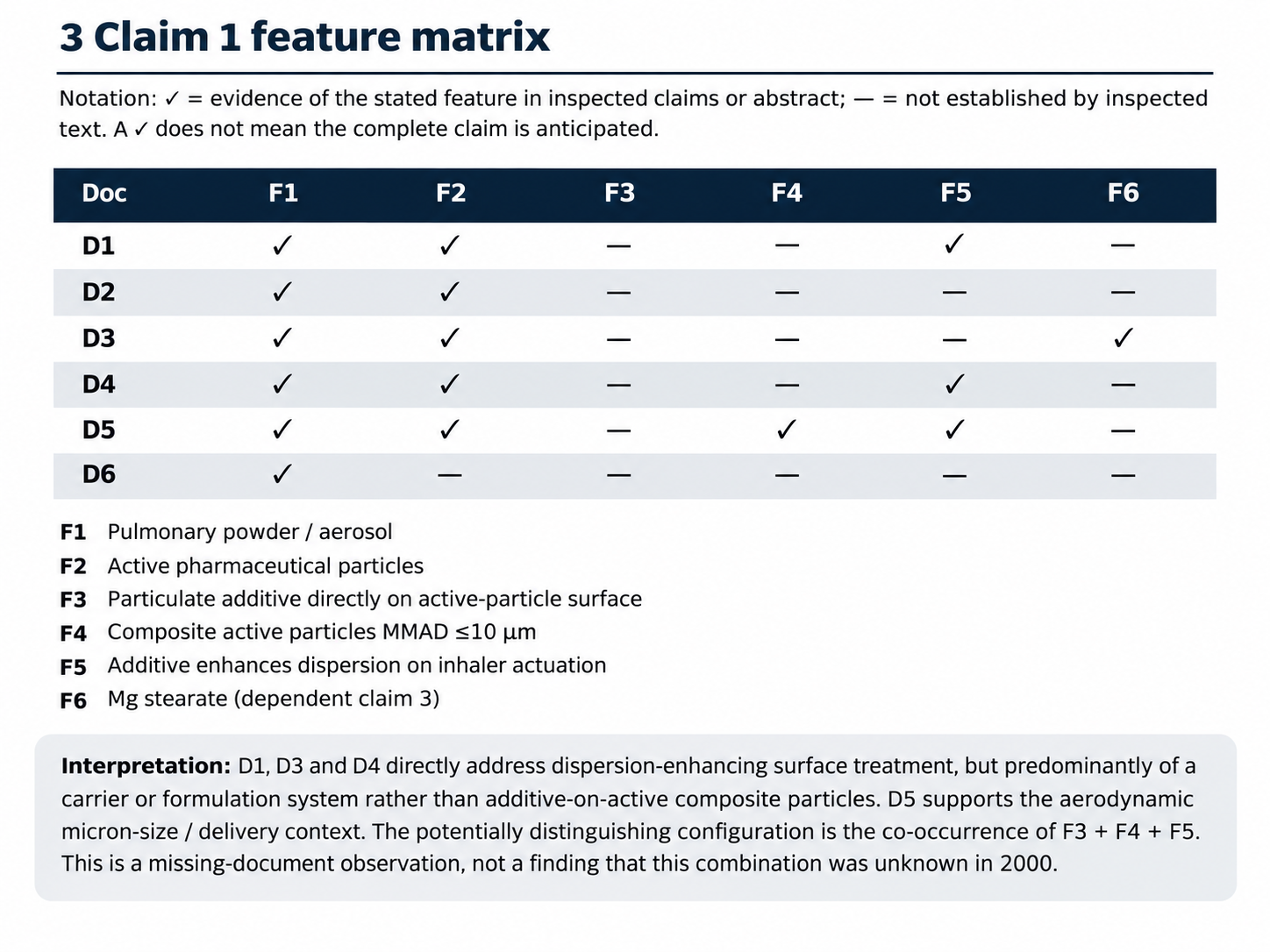
- Feature matrix. Map each document against the innovative features. A missing check is an unresolved research question, not proof that the feature is novel.
- Written opinion, white space and next steps. Explain the principal risks, what remains unverified and whether to strengthen claims, test an embodiment or continue searching.
From Espacenet queries to feature-driven citation searches
We begin with Espacenet, the European Patent Office's free public search service for patent documents from around the world. It provides an initial view of published inventions, patent classifications and relevant technical disclosures. Gate IP uses EPO patent-data services to build and check this first search.
Espacenet draws on the European Patent Office's worldwide DOCDB patent database, the same core data foundation used by many professional patent-search platforms. The EPO has done an impressive job collecting and standardising patent information from around the world. Today, the competitive challenge is less about who holds the documents and more about who can find the most relevant prior art. The difference lies in search algorithms and methodology: improving recall (finding relevant documents that conventional searches miss) and precision (reducing irrelevant results). This is why Gate IP combines structured Espacenet-based queries with Ambercite's mathematical citation-network search and feature-driven iterations.
The analyst constructs a proper search query from the innovative features: technical concepts, synonyms, CPC/IPC classification codes, Boolean combinations and truncation or wildcard operators to capture related word forms. The query is iteratively broadened and narrowed, with the results checked for technical relevance.
From this first stage we identify and verify a small set of seed patents. These become the starting points for Ambercite's citation-network searches, which explore backward, forward and indirect citation relationships across neighbouring technologies.
The feature matrix then guides each additional iteration. Instead of repeating a generic search, we refine the Espacenet query or choose different citation seeds to investigate innovative features that remain absent, partially covered or uncertain.
In the LIM-Hardcoat patentability sample, the initial concepts covered anti-fingerprint display surfaces, mesoporous or liquid-infused technology and coating processes. Verified patent seeds supported an initial citation-network pass, followed by separate optical/display and process/materials re-angles.
In the Vectura validity sample, EPO concept searches helped identify earlier inhalation-powder patent seeds. Five Ambercite passes then explored carrier powders, magnesium-stearate formulations, fine-particle delivery and reciprocal citation relationships. Each re-angle tested a different technical gap in the independent claim.
View patentability knockout sample ↗ · View validity knockout sample ↗

Why use citation-network mathematics?
Patent terminology changes across applicants and technical fields. Ambercite explores mathematical relationships among backward citations, forward citations and their indirect neighbours, identifying potentially relevant patents that keyword searches may overlook. A new, verified starting patent can take the search into a different citation cluster.
The citation graph can be explored without sending every patent's full text to an LLM. This keeps initial discovery comparatively light in language-model tokens; text-heavy verification can be reserved for the most relevant documents. Citation similarity and Amberscore are discovery aids, not validity scores.

A 2025 study involving researchers associated with the Swiss Federal Institute of Intellectual Property evaluated six ranked patent-search systems, including Ambercite, against references introduced in 16 historical chemistry opposition cases. It is a useful independent validity-oriented benchmark, though not evidence of universal superiority. An earlier Austrian Patent Office comparison reported by Ambercite found strong results for its citation approach on that benchmark.
Knockout discovery is not full-text proof
These two samples are knockout searches: they identify relevant prior-art candidates and unresolved issues efficiently. They are not exhaustive patentability or validity opinions.
For professional engagements, Gate IP can add a full-text evidence verification module to inspect original patent documents and substantiate feature comparisons with exact quotations and page or line references. This requires more AI tokens, but provides a stronger, auditable evidence trail. A claim element suggested by an abstract is not yet proven by a source passage.

A good search does not just find more patents. It uses each result to decide which innovative feature to investigate next.
Try the tools yourself, or let us do the search.
Questions? hello@gate-ip.com
The reports are preliminary, non-exhaustive technical samples, not legal opinions. X/Y/A labels are analyst assessments rather than official patent-office classifications. Final conclusions require complete source verification, relevant legal standards and appropriate professional review.